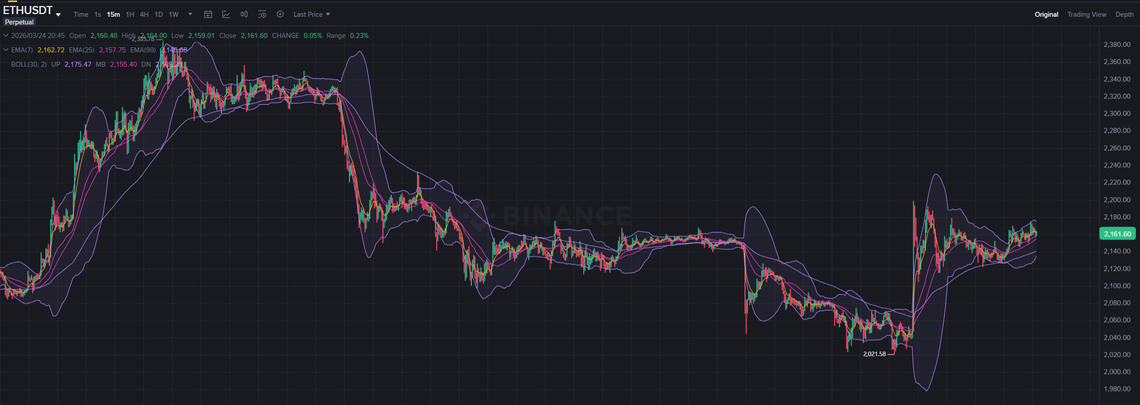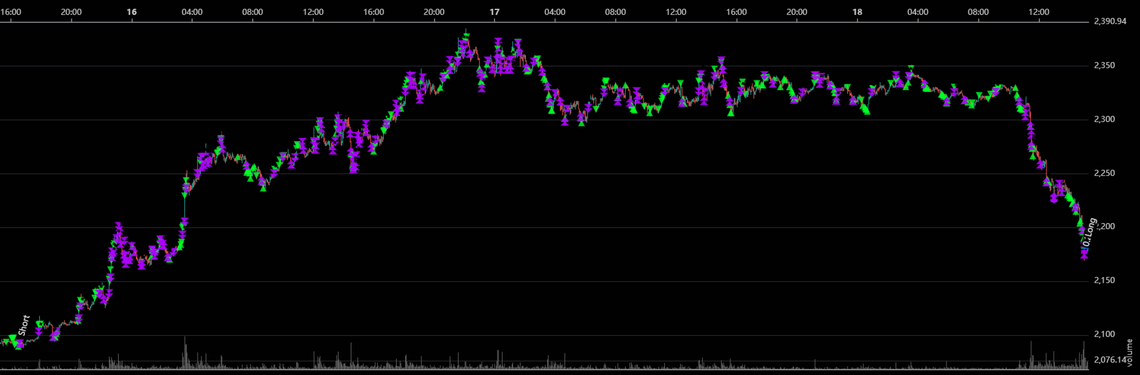

In crypto and technology-asset markets, the hard part has never been finding a rising market. The hard part is maintaining discipline, controlling risk, and preventing the system from losing control when prices reverse sharply, liquidity dries up, regulatory news hits, and leveraged liquidations cascade.
Recent markets reflect exactly this dynamic. Bitcoin has been oscillating in the $76,000–$81,000 range while markets digest rate decisions, the failure of U.S. crypto regulatory legislation, and shifting capital flows — short-term rallies and pullbacks have been alternating within very short timeframes.
Wibnay.io's V3.8 system is not a trading tool that relies on single-market predictions. It is a systematic trading framework built on large-scale search, multi-layer validation, risk-based elimination, and execution discipline. Its goal is not to chase every price move, but to identify trading opportunities with verifiable conditions — and to exit by rule the moment those conditions no longer hold.
V3.8 asks only one core question:
When the market stops behaving like the training data, can the system still control losses, avoid losing control, and maintain a verifiable operating logic?
Design principle: prove survival first
V3.8's research began with a failure. A legacy configuration that posted +25.75% in a short test window — with an attractive win rate and zero liquidations — collapsed to −99.98% with 4 liquidations once tested over a 24-month window. A high win rate still ended at zero.
That result was not buried. It became V3.8's design standard:
- Returns are no longer the final ranking criterion; the ability to survive across market regimes is the prerequisite.
- Any candidate combination that produces a liquidation during validation is immediately eliminated — 450000 epochs were excluded this way during the research process.
- Strategies must pass multi-layer testing on unseen data, alternative quote-asset price paths, and longer time windows.
- Rank #1 in training does not mean deployable. During the V3.8 process, the top-ranked in-sample candidate turned negative out-of-sample, and every eliminated case is preserved in the research record.
ETH: The primary system with a complete validation chain
ETH is currently V3.8's most mature research market. The final configuration passed not only the training window, but also pure out-of-sample data, cross-quote price-path testing, a roughly 24-month long window, and re-verification under a standardized account.
| ETH V3.8 Validation Tier | Historical Result | Liquidations |
|---|---|---|
| 12-month training window | +72.65% | 0 |
| Pure out-of-sample 12 months | +52.10% | 0 |
| Cross-quote-path out-of-sample | +37.74% | 0 |
| ~24-month long window | +133.56% | 0 |
| Standardized 12-month backtest | +169.96% | 0 |
| Standardized 24-month backtest | +273.2% | 0 |
In the standardized 12-month backtest, account equity grew from 50,000 USDT to 134,981 USDT, across 363 trades with a 94.2% win rate and a 34.73% maximum drawdown. Extended to 24 months, equity grew from 50,000 USDT to 186,602 USDT, across 795 trades with a 94.2% win rate and zero liquidations throughout.
More important is the structure of returns: over the 24-month test, long and short trades contributed approximately +64.3K and +72.3K USDT respectively. ETH V3.8 is not a product of a one-way bull market — it is a bidirectional system that operates in both directions of price movement.
QQQ: The best result from 22,000 rounds of screening
V3.8's research framework is not confined to crypto markets. Facing QQQ — an asset driven by technology stocks, rate expectations, and dollar liquidity — V3.8 executed a cumulative 22,000 training epochs, systematically testing trade frequency, profit targets, exit mechanisms, and structural variants, preserving every round's best candidates and elimination records.
After 12 rounds of systematic search, V3.8's best QQQ candidate delivered the following results:
| QQQ V3.8 Best Training Result | Value |
|---|---|
| Total training epochs | 22,000 |
| Best return | +64.98% (over ~5.4 months) |
| Trades | 104 |
| Win rate | 99%+ (virtually zero losing trades) |
| Profit Factor | 541 |
| Maximum drawdown | ~0.09% |
| Liquidations | 0 |
The clearest demonstration of V3.8's value is the head-to-head comparison in the same market over the same period: the legacy baseline recorded −39.83% with a maximum drawdown of roughly 41.26%. V3.8's representative training result not only turned positive at +40.21% with a 99.4% win rate — it compressed the maximum drawdown to approximately 0.21%. This is not a market-direction windfall; it is a structural difference created by trade selection and risk-control design.
V3.8's QQQ version posted positive returns in all six test months. Even in the months where the baseline lost heavily — April (−11,134 USDT) and August (−9,196 USDT) — V3.8 still recorded +3,733 and +2,575 USDT respectively. Roughly 88.9% of profit came from completed trades, with holding periods measured in hours — this is disciplined short-cycle risk control, not long-duration passive holding.
ETH vs. QQQ
| Comparison | ETH V3.8 | QQQ V3.8 (Best Candidate) |
|---|---|---|
| Research depth | Full out-of-sample and 24-month long-window validation | Large-scale 22,000-epoch training screen |
| Representative return | +169.96% / 12 months | +64.98% / ~5.4 months |
| Long-window cumulative | +273.2% / ~24 months | Research ongoing |
| Win rate | 94.2% | 99%+ |
| Profit Factor | — | 541 |
| Maximum drawdown | 34.73%–39.8% | ~0.09% |
| Liquidation record | 0 | 0 |
| Market character | 24/7, high volatility, bidirectional | U.S. index-style technology asset |
Both lines of research point to the same conclusion: ETH proves that V3.8 can cross multi-year market shifts with zero liquidations over 24 months; QQQ proves that V3.8 can extract a high-quality trading structure — virtually zero losing trades, extremely low drawdown, and positive returns in every test month — from a completely different asset class.
V3.8 is not a set of parameters locked to a single market. It is a methodology for systematically screening high-quality trades out of different markets.
Disclosure and confidentiality policy
Wibnay.io follows a "verifiable results, non-replicable core" disclosure principle for V3.8.
We disclose:
- Backtest periods, account equity changes, total returns, trade counts, and win rates
- Maximum drawdown, losing months, liquidation records, and monthly distribution
- Validation methodology across training, out-of-sample, long-window, and cross-path testing
- Historical failure cases and how the system was corrected as a result
We do not disclose:
- Specific parameter values, signal thresholds, entry/exit rules, or trade-frequency logic
- Position sizing, scaling structure, risk budgets, or capital allocation formulas
- Live positions, real-time trade signals, or complete trade sequences
- Any strategy details that could be used to replicate, reverse-engineer, or interfere with the system
Publishing full parameters would not only erode the system's research advantage — it could also lead outsiders to partially replicate the system without its complete risk-control context, amplifying risk rather than reducing it.
Risk disclosure
V3.8's historical results do not imply an absence of losses. Backtest records show that the ETH version experienced losing months and drawdowns of up to 39.8%; the worst single month recorded a loss of roughly 10,324 USDT. Returns were also unevenly distributed — some months contributed a large share of total gains while others were close to flat.
- All figures are historical backtest/simulation results and do not constitute investment advice, return guarantees, or solicitation of asset management.
- Zero liquidations is a historical outcome under defined risk limits and does not imply the absence of extreme risk in live trading.
- Live results may differ materially due to slippage, liquidity, exchange rules, latency, and fee changes.
- If market structure changes, any historically effective system may require re-validation or reduced exposure.
Conclusion
V3.8's achievement is not a claim to beat the market forever. It is that the system has already been subjected to harder questions: extend the timeline, change the data, alter the price path — does the system survive?
ETH's 24-month zero-liquidation record with +273.2% long-window returns, and QQQ's 22,000-epoch screening with a +64.98% best result and 0.09% maximum drawdown, are the same research discipline applied to two fundamentally different markets. Going forward, V3.8 will remain under continuous validation for market liquidity, execution slippage, and drawdown behavior. When live conditions deviate from verified historical conditions, the system's first response is to reduce risk — not to abandon discipline in order to preserve headline performance.
V3.8 makes no promises about market outcomes. It promises a verifiable process for facing every uncertainty.